


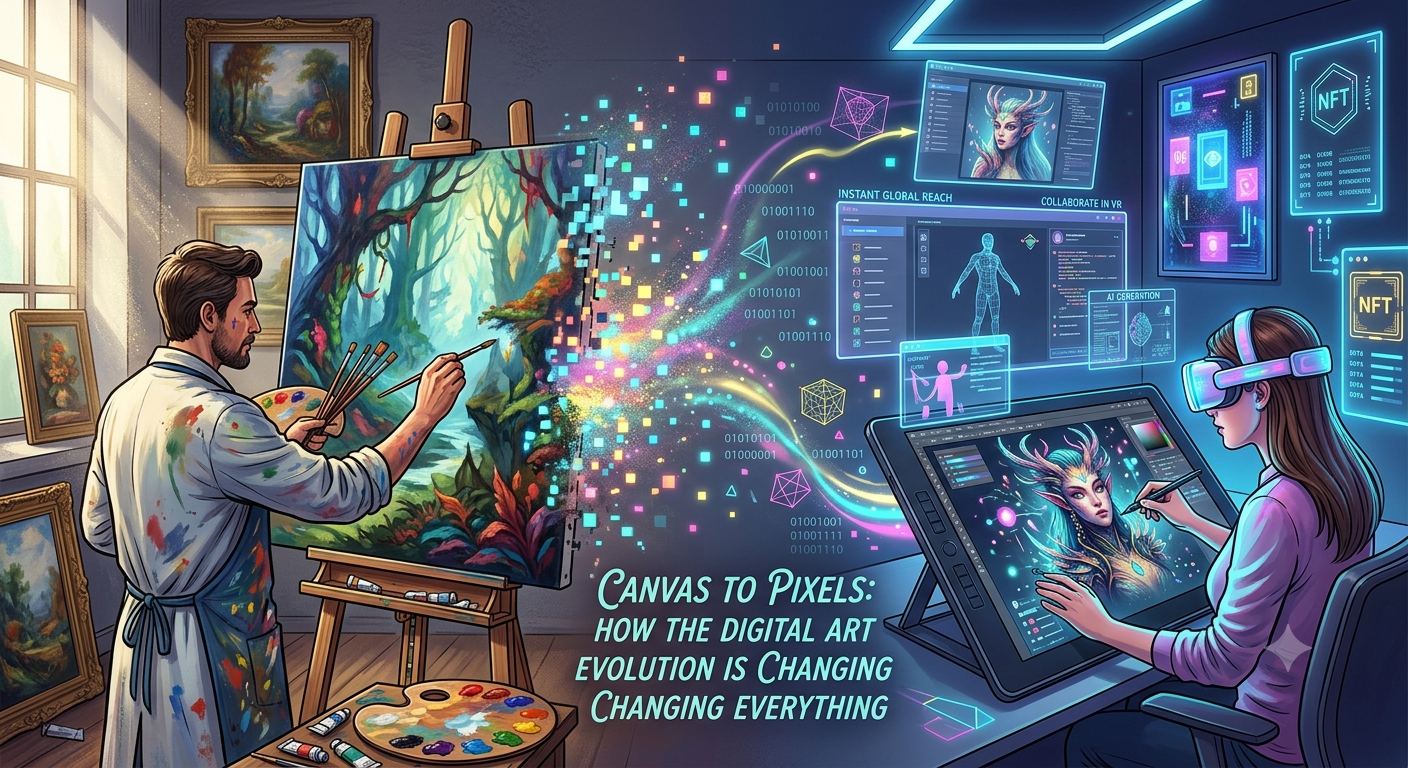
Canvas to Pixels: How the Digital Art Evolution is Changing Everything
Canvas to Pixels: How the Digital Art Evolution is Changing Everything
Gone are the days when being an artist meant getting your hands messy with oil paints, charcoal, or wet clay. While traditional mediums will always hold a special place in our hearts, there is a massive shift happening right now on our screens. We are living right in the middle of a major digital art evolution, and it is completely redefining what it means to create and collect art.
From stunning concept art in your favorite video games to mind-bending 3D animations on Instagram, digital creativity is everywhere. And honestly? It’s pretty awesome.
The Rise of the Modern Digital Artist
Today, a modern digital artist doesn’t just wield a paintbrush; they use drawing tablets, complex software, and sometimes even lines of code to bring their imaginations to life. The beauty of this digital shift is that it removes so many physical barriers. There’s no waiting for paint to dry, no running out of expensive supplies, and if you make a mistake? You just hit Ctrl+Z and try again.
But don’t let the technology fool you—digital art isn’t “easy.” It still requires the same core skills as traditional art, like understanding lighting, anatomy, color theory, and composition. The software is just the tool; the true magic still comes straight from the human brain.
From Pixels to the Blockchain and Beyond
You can’t talk about art in the digital space without mentioning the impact of crypto art and NFTs over the last few years. Love them or hate them, Web3 technology introduced something the digital art world desperately needed: a way to prove ownership. Suddenly, a JPEG or a digital animation could be bought, sold, and collected just like a rare physical painting. It allowed independent creators from all over the world to monetize their work directly without needing a middleman or a traditional gallery.
Now, we are stepping into the next wild frontier: AI-generated art and virtual reality galleries. Creators are experimenting with VR headsets to sculpt in 3D spaces, allowing viewers to literally walk inside a painting.
The future of digital creativity is wide open, fast-paced, and constantly breaking its own rules. It proves that art isn’t defined by the materials you use, but by the emotion and vision behind it. So, whether you’re sketching on an iPad or admiring a digital gallery on your phone, welcome to the future of art!